


About the Festival
The Hungry Ghost Festival—also known as Zhongyuan Festival (中元节)—is a traditional Chinese holiday rooted in Taoist and Buddhist beliefs, observed on the 15th day of the seventh lunar month. It is a time when the boundary between the living and the dead is believed to be most permeable, allowing spirits to return to the world of the living. Families honor and appease these wandering spirits—especially their ancestors—through offerings of food, incense, joss paper, and ritual ceremonies.
For Chinese American communities, the Hungry Ghost Festival is a time for us to reunite with our ancestors as they cross over from the underworld. It is a ritual of healing and honoring, especially for those whose histories have been erased or overlooked.
By memorializing our ancestors, we remember our collective history—documenting stories of migration, struggle, sacrifice, and resilience. The festival becomes both an artistic and sacred space for honoring our roots, and for channeling care, creativity, and grief into community healing. These traditional practices, rooted in Taoism and ancestral reverence, allow us to cultivate balance between the seen and unseen, the past and the present.
In this spirit, we aim to create intergenerational spaces where children of immigrants can learn the value of ancestral veneration—as storytelling, communication, and a means of preserving cultural knowledge. Proudly celebrating our ancestors is not only affirming, but also subversive; it allows us to confront generational trauma and resist the forces of exclusion that have shaped our histories.


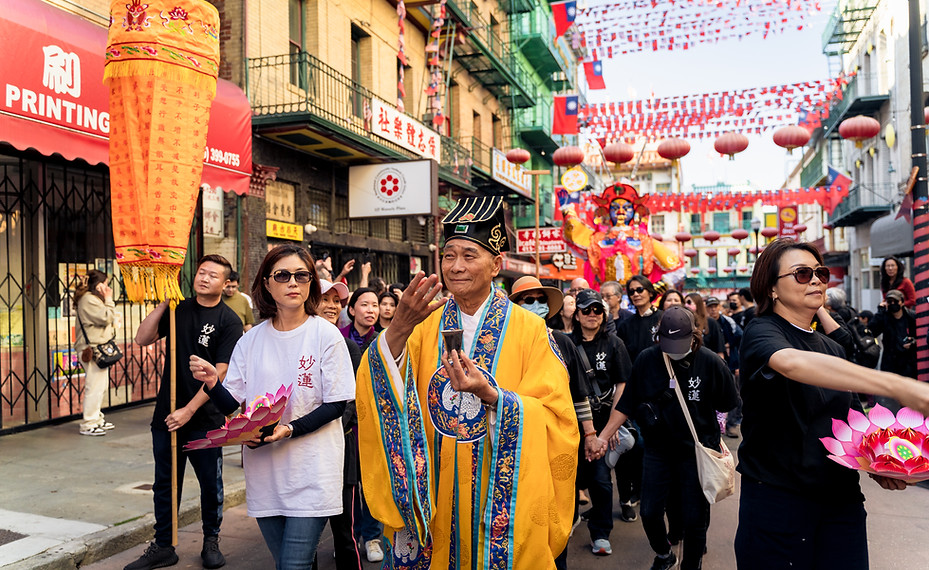
Story of the Ghost King
Out of the darkness came a ghost. Skin stretched over bone. Hair wild as burnt grass. Claws long, teeth long, and his whole face on fire — flames pouring from his mouth, and beneath the fire a throat no wider than a needle, so that no grain of rice, no drop of water, could ever pass.
The figure now paraded as the Ghost King first appears in Tang dynasty Buddhist scripture, in the tale of the monk Ānanda's midnight encounter with a burning-faced ghost king, preserved in seventh- and eighth-century translations by Śikṣānanda and Amoghavajra. The ghost, named 面燃 ("Burning Face"), warns Ānanda of his impending rebirth among the hungry dead; the Buddha's remedy — food consecrated by dharani so that one offering feeds countless beings — became the "release of the flaming mouths" rite still performed at Ghost Festival ceremonies today.
Kwun Yum assumes the body of a ghost king for those beings only a ghost king can save. When the gates of the underworld open in the seventh month, Guanyin's gentle face cannot command the ghosts, so she takes a ferocious one. In Taoism, the deity is also known as 羽林大神, a transformation of the Heavenly Worthy 太乙救苦天尊, manifested to overawe starving spirits who would otherwise mob the offerings and throw the rite into chaos.
The papier-mâché effigies made today carry this theology in their details: horns, blue-green face, fangs, flame or a long tongue at the mouth, general's armor, a command flag, and a small Guanyin seated on the crown — the quiet disclosure of who is really behind the terrible face. He presides over the offerings for the length of the festival, and when it ends the effigy is burned, sending him back to heaven.
They say the ghost was no ghost. Behind the burning face was Kwun Yum, who saw that the hungry dead had been forgotten — and wore the one face no one could ignore.

Hungry Ghost Activities
Come spend the day with us. Everything here is free and open to anyone who wanders in — bring the kids, bring your grandmother, bring a friend who has never set foot in a temple.
What happens at the Hungry Ghost Festival is loud, colorful, and very much alive (even the ghosts).
The Ghost King
Fifteen feet of bamboo frame and painted paper. He was built in Hong Kong by a master of 紙紮, the papercraft trade that also produces the paper houses and paper money we burn for the dead — a craft now on Hong Kong's intangible heritage list, kept alive by a handful of practitioners.
Look him over before the crowd builds. Two horns. Blue-green face, fangs, a tongue of flame. General's armor and a command flag in his fist: he is on duty, not on the loose. See if you can find where the Kwun Yum is, the Ghost King's true form.
He crossed the Pacific in 2023 and has presided over every Hungry Ghost Festival here since. Tradition says burn him at the end, but ours strategically withdraw instead, and waits out the year until the gate opens again.
The Fire Dragon Dance
Ten thousand sticks of incense, driven into a body of woven straw, and then the whole thing is lit. The custom comes from Tai Hang, a Hakka village in Hong Kong struck by plague in 1880. An elder dreamed the remedy: build a dragon, fill it with fire, dance it three nights running. The sickness lifted.
We called the dragon back to Chinatown in 2021, at the height of COVID, for the same reason the villagers built the first one. The smoke does the work. It moves through the street and takes with it sickness, pests, and bad energy.
Stay until 9PM to see it ignite and dance!
Peace Buns
On the altar these feed the wandering dead who have no descendants to feed them, the ones nobody else remembers. Whatever the spirits leave behind, people eat. Carrying one home means carrying home a share of the blessing.
In Hong Kong the same buns are stacked into towers on Cheung Chau every spring and scrambled up by racing teams at midnight. Here they sit quietly on the table and wait.
Offer Incense
Incense is one of the oldest forms of communication between the human and the divine. Since the Shang Dynasty (1600 BCE), aromatic herbs, woods, and resins have been burned as offerings to ancestors and deities — the rising smoke a signal sent upward, carrying intention, gratitude, and prayer.
Think of it as the original bluetooth: a way to reach those you can't see. In Taoism, the smoke bridges the world of the living with the realm of deities and spirits, and over thousands of years, this practice has woven itself into the everyday fabric of Chinese life — in temples, at home altars, during festivals, and at moments when you simply need to pause and be present.
Drawing Fortune Sticks
求籤 (kau cim) is a practice of seeking guidance through sacred oracle lots — a conversation between you and something larger than yourself. It's an ancient system of divination that dates back to the 3rd century and is still practiced in Taoist temples across China and beyond. The fortune is a piece of ancient wisdom meeting your specific moment in time. You decide what you want to do with it.
 Sat, Sep 05Grant AvenueThe gates of the underworld are open. Come to Chinatown for peace buns, incense, fortune sticks, and a straw dragon packed with ten thousand sticks of burning incense that only comes alive after dark. Free and open to all. Grant Ave, between California and Sacramento.
